As LAist reported, on July 30, a group of South LA residents and business owners gathered at Bethesda Temple Church for a meeting called "Keep the Promise." The subject was Destination Crenshaw, the $100 million public art corridor that broke ground in February 2020 and was originally supposed to open in 2024. Gregory Dulan, who has run Dulan's on Crenshaw since 1992, told the room that construction fencing and lost parking have made it hard for his older regulars to reach the door. A nearby business owner identified by LA Focus News as Colwell put it: "People can't see us." One resident described cracks appearing in her home's foundation during the ongoing work.
That meeting is worth knowing about if you're pricing a multifamily building anywhere near the Leimert Park Metro station, because it points to a mismatch that doesn't show up in a submarket rent-growth chart. Destination Crenshaw, the public art corridor proposed as an amenity on this stretch of Crenshaw Boulevard, had not met its original 2024 opening target. Meanwhile, the supply of new apartments competing for renters in the same four or five blocks is already under construction, finished, or in the pipeline.
The number that's making South LA look like the best story in LA multifamily
Start with the headline that brokers citywide have been pointing to. In the second quarter of 2026, South Central led every submarket in the Los Angeles metro in year-over-year rent growth, posting a 5.5% increase, ahead of Southeast Los Angeles at 3.7% and Long Beach at 2.7%, according to Matthews' Q2 2026 Los Angeles multifamily report. In a metro where the average cap rate has expanded for six straight quarters to 5.37% and price per unit has drifted down to roughly $308,551, a submarket actually pulling ahead on rents is a genuinely useful signal. It suggests renter demand in this part of the city is outrunning the new supply hitting the broader area.
That number is real, and it's a fair reason for a 1031 exchange buyer or a value-add investor to take South LA seriously right now. But "South Central" as a reporting category covers a wide swath of the city. It is not the same thing as the four or five blocks immediately surrounding one Metro station, where a specific and unusually concentrated construction pipeline is converging on a schedule the submarket-wide average can't isolate.
The four blocks the average doesn't see
Since the K Line's Leimert Park Station opened in October 2022, developers have projects totaling close to 400 new apartment units within easy walking distance of it:
| Project | Developer | Units | Status as of September 2026 |
|---|---|---|---|
| Crenshaw Lofts, 4611 S. Crenshaw Blvd. | SoLa Impact | 195 | Under construction |
| The Nathaniel, 4421-4437 S. Crenshaw Blvd. | Treehouse and The Apex Collaborative | 97 | Financed through a $25 million Metro construction loan; Urbanize reported that units are reserved for Metro employees earning up to 80% of area median income |
| 4345 S. Crenshaw Blvd. | Venice Community Housing | 56 | Application filed with LA City Planning in August 2026; no construction start date announced |
| 3450 W. 43rd St. | Brasa Capital Management | 56 | Completed |
That's roughly 404 units across projects at different stages in a footprint small enough to walk end to end in under ten minutes. Some of it is workforce housing, some is fully affordable, and none of it competes head-on with a market-rate value-add deal unit for unit. But it still absorbs renter demand, occupies leasing agents' attention, and shapes what a comparable unit down the street can actually command while it fills up. A citywide or even submarket-wide rent growth figure has no way to flag that kind of hyper-local concentration. It gets smoothed into the average along with every other block in South Central that isn't seeing anything like this volume of delivery at once.
For an owner of a 6-to-16-unit building two or three blocks from the station, that distinction matters. Most of Leimert Park's existing apartment stock was built between 1940 and 1965. Existing buildings are working from whatever their rent roll already reflects, unit by unit, tenant by tenant.
The amenity half of the equation is moving slower than the supply half
The standard argument for buying near a transit line is that it's a long-hold thesis: ridership builds, walkability improves, and eventually rents and pricing catch up, the way they did along the Expo Line in Palms and Culver City over the years following that line's opening. Nothing in the research here contradicts that pattern as a multi-year story.
What's worth sitting with is the timing gap between the two halves of that story in this specific case. Destination Crenshaw is the piece designed to do the heavy lifting on the demand side, the "reason to want to live here" that eventually pulls rents up. Sankofa Park, its flagship component, was reported to be roughly 95% complete as of July 2026, with backers targeting a fall opening timed to coincide with the new LAX people mover connection to the K Line. Representative Sydney Kamlager-Dove, who helped secure funding for the project, has said publicly that it "must open well before Los Angeles welcomes the world for the 2028 Olympic Games." That fall opening target follows the project's February 2020 groundbreaking and its missed February 2024 opening target. Meanwhile, the residential side of the story, the new unit supply, runs on private construction schedules that don't depend on public funding cycles the same way, which is part of why 195 units at Crenshaw Lofts are already framed and 56 units at 43rd Street are already leased up while Destination Crenshaw's public amenity remains under construction.
An investor underwriting a 7-to-10 year hold on the transit thesis is making a reasonable bet. An investor underwriting a near-term rent bump because a train station opened four years ago is pricing in a demand driver that, as of this fall, still hasn't fully opened for business.
What the cap rate is already telling you
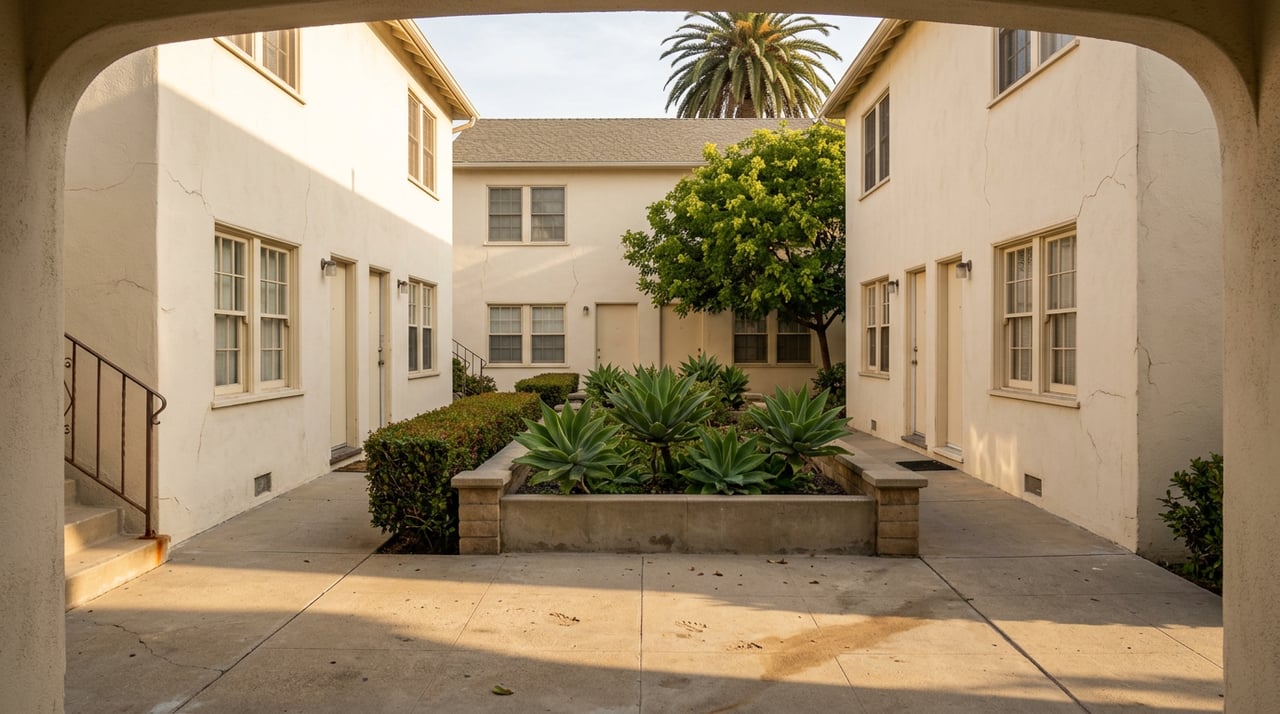
This is largely priced in already, which is exactly the point. Multifamily cap rates in Leimert Park have been running in the 5.5% to 7.0% range through mid-2026, wider than comparable Northeast LA submarkets like Eagle Rock, which have traded closer to 4.8% to 6.5% over the same period. That spread isn't a discount for lower building quality. Leimert Park's stock includes plenty of well-maintained 1930s and 1940s Spanish-style courtyard buildings that hold up fine on condition. The wider cap rate is compensation for exactly the risk this piece is describing: a concentrated, near-term supply wave landing before the amenity that's supposed to justify a premium has finished construction.
What this means depending on where you sit
If you're a long-time owner of a Leimert Park building weighing a sale, the current cap rate range already reflects the supply story. You're not leaving value on the table by selling into it, since a quick repricing tied to Destination Crenshaw's opening has not materialized by its original 2024 target.
If you're a 1031 exchange buyer drawn to South LA's yield story, the submarket-wide rent growth number is a legitimate reason to look here. Just underwrite the half-mile radius around the station separately from the submarket average, and model absorption time for your comparable units against the roughly 400-unit pipeline rather than against a citywide figure that doesn't isolate it.
If you're an emerging buyer targeting a smaller building, the new supply nearby is turning over on a construction schedule you can actually track. Price the deal on today's rent roll, not on where the K Line narrative says rents will eventually land.
FAQ
Does the K Line raise apartment values in Leimert Park? Over a long hold period, transit access has historically supported multifamily appreciation in comparable LA corridors, including the Expo Line in Palms and Culver City. In Leimert Park specifically, that effect is still an early-stage, multi-year thesis rather than something already reflected in near-term rents.
When is Destination Crenshaw expected to open? As of mid-2026, Sankofa Park, the project's main component, was reported to be roughly 95% complete, with a targeted fall 2026 opening. The project has missed several previous opening dates since breaking ground in February 2020, so treat any specific date as a target rather than a certainty.
Is Leimert Park still worth considering for a 1031 exchange? It can be, particularly given South Central's strong rent growth in 2026. The key is underwriting the immediate station-area supply pipeline separately from submarket-wide averages, since roughly 400 new units are concentrated in a small radius around the K Line station.
Leimert Park's numbers are more interesting than a single submarket average can capture, and that's precisely why they deserve a closer look before you write an offer. Evans Investment Group works with owners and investors across South Los Angeles and Ventura County who want their underwriting to reflect what's actually happening block by block, not just what the citywide report says. Contact us to talk through what a specific Leimert Park address is worth in today's market.
This article is general information, not legal, tax or financial advice. Consult a qualified professional about your situation.